Smog Check Exemptions: Which Vehicles Do Not Need Testing?
If you own a car in the United States, there’s a good chance you’ve dealt with a smog check or emissions inspection at some point. For many drivers, it’s just part of renewing registration. But not every vehicle is required to go through emissions testing.
That raises a common question:
Which vehicles are exempt from smog checks?
The answer depends heavily on your state, your vehicle type, and sometimes even your county. There is no universal national exemption rule.
At SmogTestNearMe.com, one of the most common questions we hear from drivers is whether their vehicle qualifies for an exemption. The confusion makes sense because emissions laws vary widely across America.
This guide breaks down the most common smog check exemptions, how they work, and what vehicle owners should know before assuming they can skip testing.
Why Smog Checks Exist in the First Place
Smog checks exist to reduce harmful vehicle emissions.
The Environmental Protection Agency oversees national air quality standards, but individual states operate their own vehicle inspection and maintenance programs under the Clean Air Act. These programs identify vehicles producing excessive emissions and require repairs when necessary. (US EPA)
The goal is simple: cleaner air.
But states also recognize that not every vehicle needs regular testing.
That’s where exemptions come in.
The Most Common Smog Check Exemptions
While every state is different, these are the most common categories of exemption.
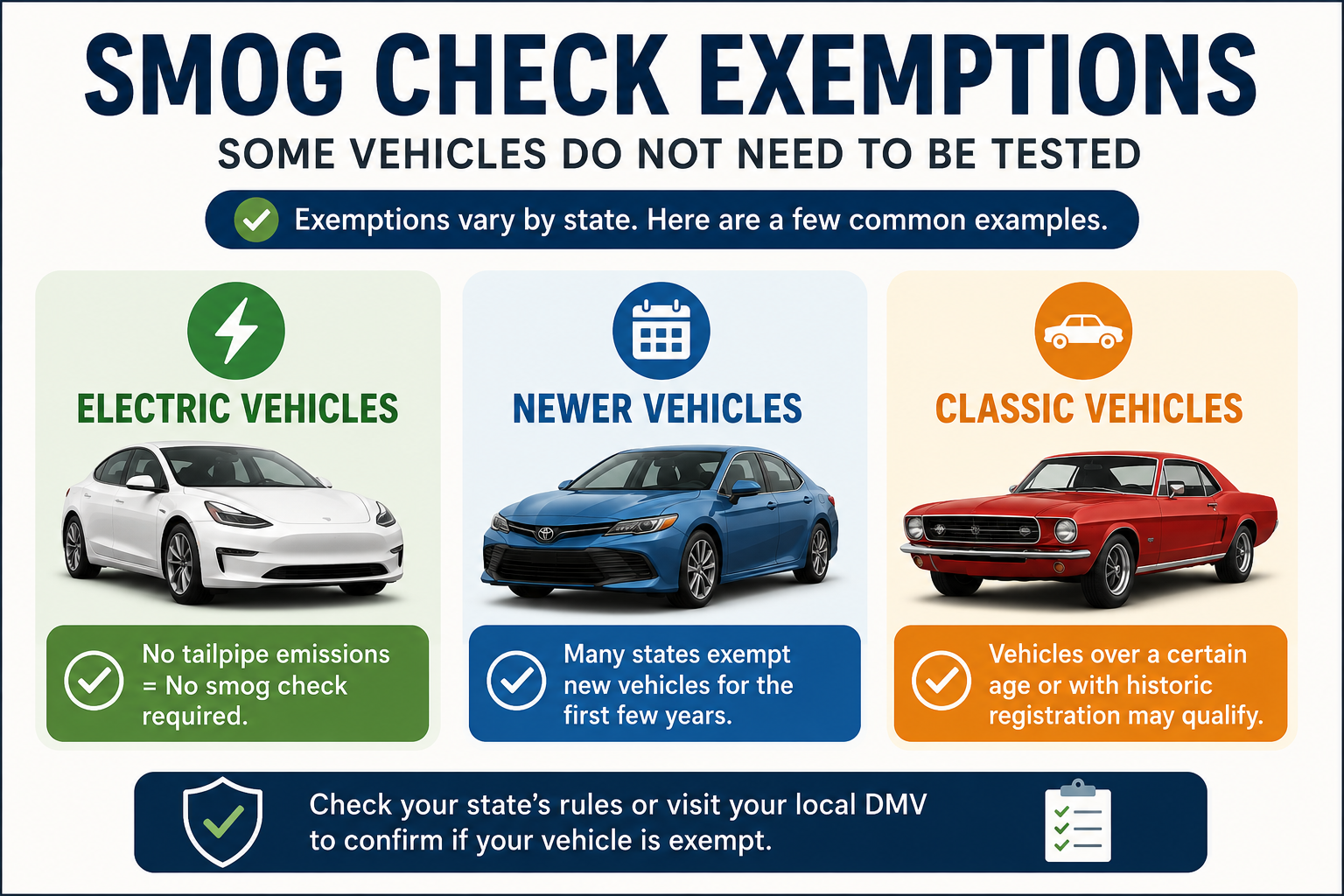
1. Electric Vehicles (EVs)
This is the easiest exemption to understand.
Electric vehicles have no tailpipe emissions.
That means they are almost always exempt from traditional smog checks.
Examples include:
Tesla Model 3
Nissan Leaf
Ford Mustang Mach-E
If your car runs entirely on electricity, you will almost never need an emissions test.
Some states may still require VIN verification or safety inspections.
2. Newer Vehicles
Many states exempt newer vehicles because they are built under stricter emissions standards and statistically have fewer emissions-related issues.
Common exemption windows:
First 4 years
First 6 years
First 8 years
For example, some states charge an abatement fee instead of requiring a smog inspection during early ownership.
This exemption saves time and reduces administrative burden.
But do not assume your new car is exempt forever.
That exemption eventually expires.
3. Classic and Antique Vehicles
Older collector vehicles often qualify for exemptions.
These usually apply if:
The vehicle is over a certain age
It has historic registration
It is driven limited miles annually
Examples:
25 years old
30 years old
Pre-1975 in some states
Classic vehicle exemptions exist because these cars are driven less frequently and contribute less overall pollution.
Important note: some states still require visual inspections.
4. Hybrid Vehicles (Sometimes)
Hybrid exemptions vary more than people expect.
Some states exempt certain hybrids for a limited time, while others require them to test like gasoline vehicles.
Examples of hybrid vehicles:
Toyota Prius
Honda Accord Hybrid
Plug-in hybrids may receive different treatment than standard hybrids.
Always verify with your state.
5. Diesel Vehicles (Sometimes)
Diesel vehicles are a special case.
In some states:
Light-duty diesels require testing
Heavy-duty diesels may follow separate rules
Older diesels may be exempt
This depends heavily on vehicle weight and model year.
Diesel rules are often different from gasoline vehicle rules.
6. Motorcycles
Many states exempt motorcycles from emissions testing.
That includes brands like:
Harley-Davidson Street Glide
Honda Gold Wing
Motorcycle emissions programs are less common than passenger vehicle testing.
Still, some states may regulate certain motorcycle classes.
7. Farm Vehicles
Vehicles registered strictly for agricultural use are often exempt.
These may include:
Farm trucks
Agricultural utility vehicles
Specialty equipment
These vehicles usually operate under limited-use classifications.
8. Low Mileage Vehicles
Some states offer exemptions for vehicles driven below a certain annual mileage threshold.
Common mileage limits:
Under 5,000 miles per year
Under 7,500 miles per year
Proof may be required.
This exemption is often tied to collector vehicles or special registrations.
State-by-State Examples of Smog Exemptions
Here’s where things get more specific.
California
California has some of the strictest emissions laws in the country.
Common exemptions include:
Gasoline vehicles model year 1975 and older
Electric vehicles
Some newer vehicles (temporary abatement period)
California generally requires biennial testing for many vehicles.
Texas
Texas exemptions often include:
New vehicles within a certain age range
Electric vehicles
Vehicles outside emissions counties
Texas emissions requirements are county-based. (Texas Department of Public Safety)
That means location matters.
New York
In New York:
Electric vehicles are exempt from emissions testing
Some older vehicles may qualify for special treatment
Most 1996 and newer gasoline vehicles still require OBD-II testing. (Legal Information Institute)
Illinois
Illinois commonly exempts:
Electric vehicles
New vehicles for a temporary period
Vehicles outside emissions regions
Testing is focused in the Chicago metro area.
Arizona
Arizona often exempts:
New vehicles
Electric vehicles
Some specialty vehicles
Testing requirements are concentrated in Phoenix and Tucson.
Common Mistakes Drivers Make About Exemptions
A lot of drivers assume they are exempt when they are not.
Here are common mistakes:
Assuming all old cars are exempt
Age rules vary by state.
Thinking hybrids are always exempt
They are not.
Forgetting county-based rules
Some states only test in certain areas.
Confusing safety inspections with emissions testing
They are different.
A vehicle may be exempt from emissions but still need a safety inspection.
How to Check If Your Vehicle Is Exempt
Before skipping your smog check, verify your status.
Check:
Your state DMV website
Your registration renewal notice
Your emissions program website
Local county requirements
At SmogTestNearMe.com, we always recommend confirming directly before assuming exemption status.
One wrong assumption can delay your registration.
Do Exempt Vehicles Ever Need Testing?
Sometimes, yes.
Examples:
Ownership transfers
Moving to another state
Registration changes
Special inspections after modifications
Exempt does not always mean permanent.
Circumstances can change.